7
Tires do not wear down evenly by accident. Every mile driven leaves an indelible mechanical footprint on the rubber, translating the forces of steering input, chassis movement, and pavement impact into a physical record. When a driver spots thin tread along an edge or hears a rhythmic hum at highway speeds, the default reaction is often frustration with the tire manufacturer. Yet premature or irregular tread loss is rarely a defect of the rubber itself. Instead, tires serve as the most accurate diagnostic window into the health of a vehicle’s steering geometry and suspension components.
Before spending hundreds or even thousands of dollars on a fresh set of tires, running a hand across the tread face can reveal whether camber, toe, or failing mechanical links are throwing the chassis out of balance. Learning to interpret these physical wear patterns protects your investment, restores proper handling, and prevents brand-new tires from suffering the same fate.
Understanding Wheel Alignment: The Big Three Angles
To decode what the tread is showing, you first need to understand the three fundamental geometry angles technicians measure and correct on an alignment rack. Alignment is not simply pointing the wheels forward; it is a three-dimensional calibration that accounts for load transfer, turning radius, and straight-line stability.
Camber: The Inward and Outward Lean
Camber refers to the inward or outward tilt of the wheel when viewed directly from the front or rear of the vehicle. If the top of the tire leans toward the engine bay, the tire has negative camber. If the top leans outward away from the body, it has positive camber.
Most modern passenger cars and performance vehicles are engineered with a slight amount of negative camber from the factory, typically between half a degree and one degree. This design ensures that as the vehicle corners and the body rolls outward, the outside tire plants its entire contact patch flat against the road surface. However, when suspension springs sag, strut towers deform, or lower ball joints loosen, negative camber can become excessive. When that occurs, the tire spends its entire operational life riding heavily on its inside shoulder, grinding away rubber that should have lasted for years.
Toe: The Angle That Destroys Tires Fastest
Toe is the direction the tires point relative to the vehicle centerline when viewed from above, much like looking down at your own feet. If the front edges of the tires point inward toward each other, the vehicle is toed-in. If the front edges angle outward, it is toed-out.
While improper camber causes gradual wear across a specific edge, incorrect toe is the single most destructive alignment error for tread longevity. Even a variance as small as one-sixteenth of an inch forces the tire to scrub diagonally down the highway. Rather than rolling freely along the pavement, a tire with incorrect toe is effectively dragged sideways across abrasive asphalt for thousands of miles. A severe toe problem can scrub a tire completely down to the steel cords in just a few thousand miles of normal commuting.
Caster: The Steering Axis Pivot
Caster describes the forward or backward tilt of the steering axis when viewed from the side of the vehicle. Think of the front fork of a bicycle: the fork angles forward toward the axle, creating positive caster. This angle provides directional stability, keeps the car tracking straight on the highway, and allows the steering wheel to snap back to center after you complete a turn.
Unlike camber and toe, caster does not usually cause direct, linear tire wear when a car travels in a straight line. However, if the caster angle is mismatched between the left and right sides—known as cross-caster—the vehicle will pull toward the side with less positive caster. The driver must constantly apply counter-steering torque to hold the vehicle straight, which introduces side-scrubbing forces that accelerate wear on the front steering axle.
Decoding the Most Common Alignment Wear Patterns
Different mechanical issues produce distinct textures and wear signatures across the tire carcass. Identifying the exact pattern helps you distinguish between an alignment angle error and a worn mechanical component.
One-Sided Shoulder Wear
When the tread depth disappears along one edge while the opposite edge retains healthy tread depth, you are looking at one-sided shoulder wear.
Inner edge wear is far and away the most common complaint among modern drivers. On independent suspension setups, worn control arm bushings, sagging coil springs, or bent struts allow the suspension to settle downward, driving the wheel into severe negative camber. Lowered vehicles that lack aftermarket camber correction kits suffer from this pattern constantly.
Outer edge wear occurs less frequently on modern commuter vehicles, but it is equally problematic. It typically points to excessive positive camber or worn upper ball joints on older truck suspensions. If both front tires show heavy wear on the outer shoulder, aggressive cornering at high speeds may also be compounding an underlying geometry fault.
Feathered Tread
Feathering is the classic signature of toe misalignment. In this pattern, the individual tread blocks wear down smoothly on one side while developing a raised, razor-sharp edge on the opposite side.
Because feathering can be subtle during visual inspection, automotive technicians rely on the palm test to confirm it. If you slide your bare hand across the tire tread from the inner shoulder toward the outer shoulder, the surface might feel smooth. When you slide your hand in the opposite direction, the raised edges of the tread blocks will catch against your skin like the scales of a fish. If the sharp edges face the inside of the vehicle, the car has excessive toe-in; if they point outward, the car has excessive toe-out.
Heel-Toe Wear
Heel-toe wear looks similar to feathering, but it runs circumferentially around the tire rather than across the width. If you inspect an individual tread block from the side, the leading edge where the rubber strikes the road first is worn low, while the trailing edge remains tall, creating a jagged sawtooth profile.
A minor amount of heel-toe wear is an inevitable byproduct of normal tire deflection under torque and braking. However, pronounced heel-toe wear creates significant road noise that sounds identical to a failing wheel bearing. This condition is accelerated by improper toe settings and failure to rotate the tires at scheduled intervals, which prevents the tread blocks from reversing their rotational contact direction.
Alignment Issues vs. Suspension and Pressure Problems
Before assuming your alignment is solely to blame for damaged tread, it is critical to separate alignment patterns from issues caused by failing shock dampening or incorrect tire inflation.
Cupping and Scalloped Tread
Cupped tires display distinct scooped depressions or oval divots around the circumference, often alternating between high and low spots every few inches. Many motorists mistakenly attribute cupping to alignment error, but this pattern is almost always caused by worn shock absorbers, failing struts, or loose suspension links.
When a shock absorber loses its hydraulic damping ability, it can no longer control the natural oscillation of the suspension spring. As the car hits surface imperfections at highway speeds, the wheel bounces rapidly like a basketball. Each time the tire slams back onto the pavement, it gouges away a patch of rubber. Unbalanced wheel assemblies can cause an isolated flat spot, but repeating scalloped cups around the entire perimeter signify that the suspension dampening has failed.
Center Wear and Dual-Shoulder Wear
Tire pressure directly shapes the contact patch that touches the ground, which can mimic or exacerbate alignment faults.
When a tire is chronically over-inflated, the center ribs bulge outward and bear the full weight of the vehicle. This causes the middle channel to wear bald while both outer shoulders keep their tread depth. Conversely, under-inflation allows the center of the contact patch to collapse inward, shifting the vehicle load onto both shoulders simultaneously. If both outer edges are worn but the center is intact, air pressure is the culprit rather than wheel alignment.
How to Conduct an Accurate Tread Inspection at Home
Catching geometry issues early requires proactive inspections before the vehicle begins wandering across highway ruts.
Turn the front steering wheel to full lock to expose the inner shoulders of the front tires. Because inner edge camber wear occurs tucked deep under the fender well, it frequently goes completely unnoticed until the tire suddenly loses air pressure or exposes dangerous steel belt braiding.
Glide your flat palm across the tread width in both directions to feel for the telltale biting edges of toe feathering. Listen closely for any changes in road noise during daily driving. A humming or roaring sound that shifts in pitch during sweeping turns often points to uneven tread surfaces before the damage becomes glaringly visible.
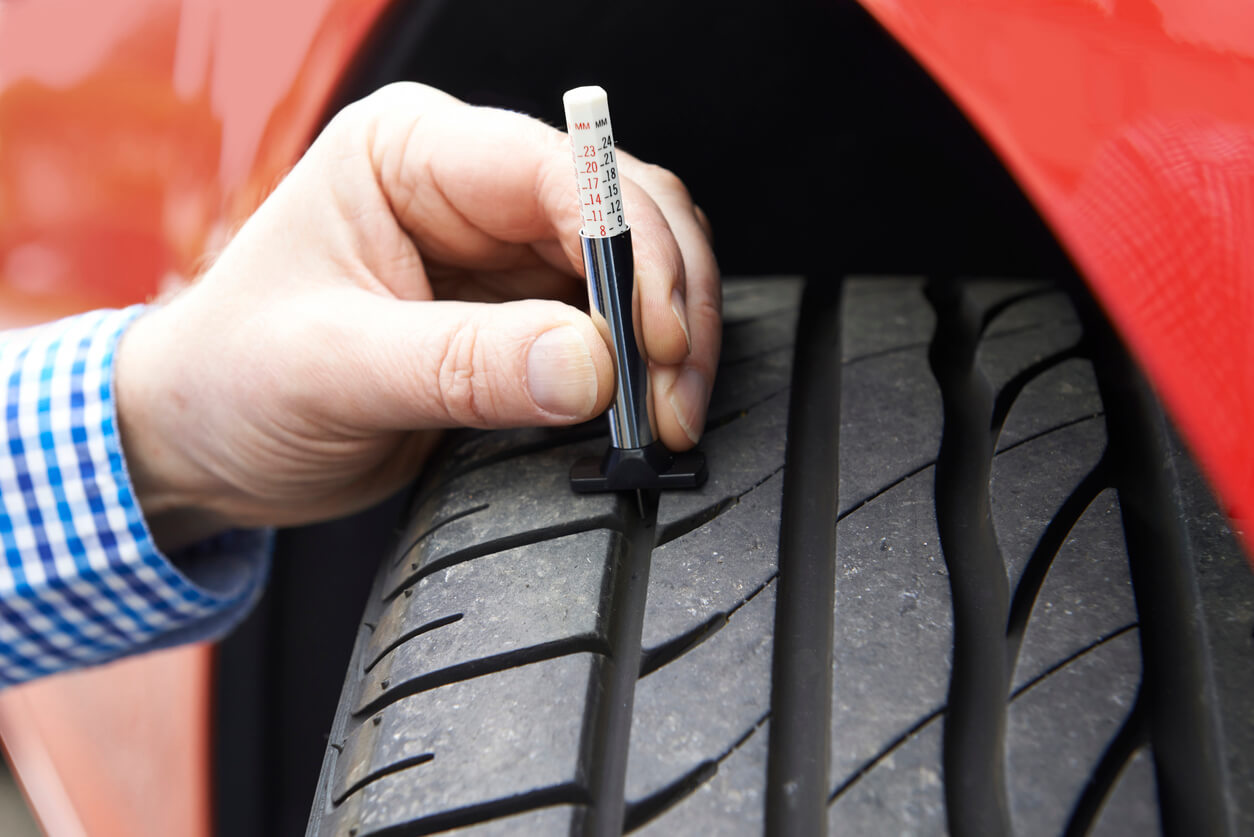
Use an inexpensive tread depth gauge to measure the outer, center, and inner circumferential grooves. If there is a variance of more than two-thirty-seconds of an inch across the face of a single tire, the vehicle has an active geometry or inflation defect that requires professional attention.
The Broader Impact on Safety and Fuel Economy
Driving on misaligned wheels carries consequences that go far beyond buying replacement tires sooner than planned. When wheels fight each other instead of rolling in unison, the engine must burn more fuel to overcome the increased rolling resistance. A vehicle with measurable toe misalignment can experience a fuel economy drop of five to ten percent under sustained highway cruising.
Safety is compromised even more severely. Tread channels are precisely engineered to evacuate water and prevent hydroplaning. When alignment scrubs one shoulder smooth, the tire loses its ability to pump water away from the contact patch, dramatically increasing the risk of uncontrolled skids on wet highways. Furthermore, uneven tread contact patches produce erratic behavior during emergency braking, leading to unpredictable anti-lock brake system cycling and noticeably longer stopping distances.
Getting the Most from an Alignment Service
When you bring your vehicle in for alignment service, request a comprehensive four-wheel alignment rather than a front-end thrust adjustment. Many modern vehicles feature independent rear suspensions that can drift out of spec, causing the rear axle to track sideways and throwing off the entire chassis geometry.
Always ask the service facility for a before-and-after printout showing the precise caster, camber, and toe specifications for all four wheels. A reputable technician will also inspect control arm bushings, tie rod ends, and wheel bearings before touching the alignment adjusters. Performing an alignment on worn or loose suspension components is entirely ineffective, as the hardware will flex out of tolerance the moment the vehicle backs off the service rack.
Paying attention to your tread turns an unpredictable repair bill into predictable preventative care, ensuring every set of tires delivers the full safety and mileage performance built into it.
