4
The term all-season is perhaps the greatest branding triumph and automotive engineering compromise ever conceived. For decades, drivers across North America have purchased vehicles fitted with all-season rubber under the reasonable assumption that the name means what it says. If a product claims to handle all four seasons, preparing for a routine winter storm should require little more than checking tire pressure and scraping frost off the windshield.
The 45-Degree Threshold: Why Temperature Trumps Snow
The most pervasive winter driving myth is that dedicated snow tires are only beneficial when pavement is covered in white powder. Drivers frequently look outside at bare, dry asphalt in January and conclude that their all-season tires are more than sufficient. This perspective ignores the fundamental variable of tire performance: ambient road temperature.
Rubber compounds are governed by a chemical threshold known as the glass transition temperature. All-season tires are formulated with synthetic polymers designed to withstand scorching summer highway temperatures without melting or blistering. Because they must endure blazing heat, these compounds begin to stiffen as ambient temperatures dip. Once the thermometer falls below 45 degrees Fahrenheit, the tread rubber on an all-season tire begins to harden significantly.
At sub-freezing temperatures, an all-season tire behaves less like pliable rubber and more like a hard plastic hockey puck. It can no longer flex and deform into the microscopic textures and aggregate of the road surface, dramatically reducing mechanical grip.
Winter tires, by contrast, are engineered with specialized rubber compounds packed with high concentrations of silica and natural rubber polymers. These advanced formulations remain soft, supple, and malleable in temperatures well below zero. Even on bone-dry pavement on a freezing afternoon, a dedicated winter tire provides superior mechanical grip and substantially shorter stopping distances than an all-season tire simply because the rubber retains the flexibility required to cling to the road.
Tread Geometry and the Mechanics of Cold Traction
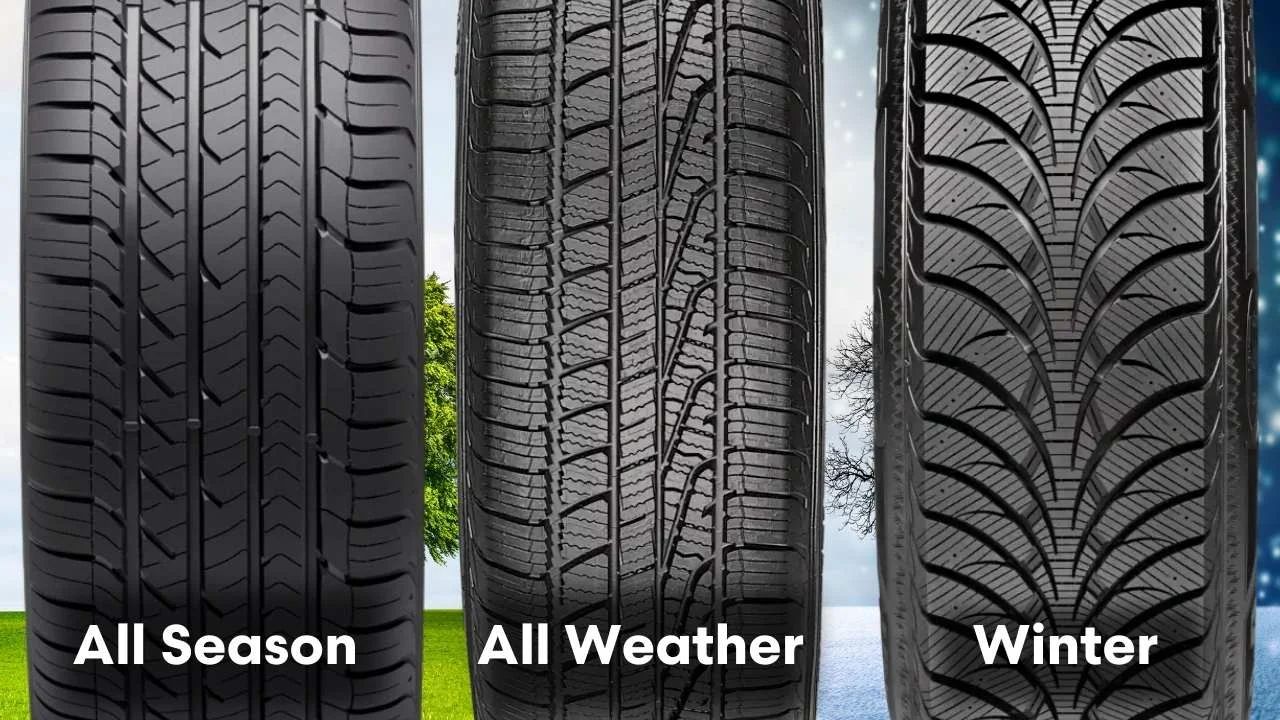
If you place an all-season tire next to a dedicated winter tire, the visual differences in tread architecture are immediate and pronounced. Every channel, cut, and block on a winter tire is mapped to manage water, slush, and frozen precipitation.
Sipes and the Power of Microscopic Biting Edges
The most striking visual element of a winter tire is the presence of thousands of microscopic, razor-thin slits carved across every tread block. These incisions are known as sipes. While an all-season tire features a modest number of straight sipes, a winter tire is covered in an aggressive, high-density network of zig-zagging three-dimensional sipes.
Sipes serve two vital mechanical functions on snow and ice:
First, as the tire rolls and encounters road resistance, the sipes flex open, creating thousands of tiny, razor-sharp biting edges that dig directly into packed snow and glazed ice.
Second, sipes act as miniature squeegees. When a tire drives across ice, the friction and concentrated vehicle weight create a microscopic film of liquid water. This thin sheet of water is what causes uncontrolled hydroplaning over frozen surfaces. Winter tire sipes draw this liquid film into their tiny channels via capillary action, temporarily clearing the surface so the rubber can make direct, physical contact with the road.
Deep Directional Grooves and Slush Evacuation
All-season tires rely heavily on continuous circumferential grooves that run straight around the perimeter of the tire, designed primarily to evacuate standing summer rain. While effective in warm downpours, these straight channels quickly choke when forced to process thick, heavy winter slush. Once packed with slush, an all-season tire loses its contact patch and floats across the slush layer.
Winter tires feature aggressive directional or asymmetrical tread blocks separated by deep, wide lateral voids. These sweeping channels actively pump slush, wet snow, and freezing mud outward from the center of the tire toward the outer shoulders, maintaining consistent rubber contact with the asphalt underneath.
The Snow-on-Snow Traction Principle
One of the most counterintuitive aspects of winter tire design is that the tread voids are intentionally shaped to trap and pack snow within the grooves.
Tire engineers utilize a fundamental physical principle: snow adheres to snow far better than rubber adheres to ice. The shear strength created when packed snow inside the tire grooves meshes with snow packed onto the road surface creates immense frictional resistance. Winter tires harness this mechanical interlocking force to generate forward thrust and stable braking where bare rubber would simply spin or slide.
The All-Wheel Drive Fallacy: Propulsion vs. Braking
The popularity of all-wheel drive (AWD) and four-wheel drive (4WD) crossovers and SUVs has created a false sense of winter driving invulnerability. Drivers frequently believe that having four driven wheels eliminates the need for specialized tires.
This assumption confuses propulsion with vehicle control. All-wheel drive directs engine torque to all four wheels, which makes it exceptionally easy to accelerate from a dead stop at an icy traffic light or crawl out of an unplowed driveway. What AWD does not do is assist the vehicle in slowing down, coming to an emergency halt, or steering around an unexpected obstacle.
Every passenger car on the road already features four-wheel braking. When you depress the brake pedal on an icy highway, an all-wheel-drive luxury SUV possesses zero mechanical braking advantage over a front-wheel-drive compact sedan. In fact, because AWD systems add several hundred pounds of mechanical weight in transfer cases, differentials, and driveshafts, the heavier AWD vehicle carries more forward inertia, requiring greater frictional force to stop.
If your tires lack the chemical pliability to grip the road surface, sophisticated electronic anti-lock braking systems (ABS) and stability control algorithms can only cycle the calipers over an uncontrolled skid. Winter tires provide the physical friction that allows your vehicle safety systems to function as intended.
Enter the All-Weather Tire: The Modern Middle Ground
In recent years, tire manufacturers have introduced a distinct middle category that has bridged much of the performance gap: the all-weather tire.
It is crucial not to confuse all-weather tires with traditional all-season tires. Traditional all-seasons carry an M+S (Mud and Snow) stamp on the sidewall, which is a geometric rating based solely on tread void area rather than certified performance testing on actual snow.
All-weather tires, on the other hand, are formulated with advanced temperature-stable compounds and feature high-density siping that allows them to earn the Three-Peak Mountain Snowflake (3PMSF) severe snow service emblem. This symbol certifies that the tire has passed standardized federal traction testing on packed snow, delivering at least ten percent better acceleration traction than a reference test tire.
All-weather tires represent an exceptional compromise for motorists who experience genuine winter weather but lack the space to store a second set of wheels or wish to avoid the expense of bi-annual tire changes. They can be driven safely through 90-degree summer heatwaves and continue to deliver dependable grip when autumn gives way to freezing temperatures.
However, all-weather tires still fall short of dedicated winter tires when conditions turn extreme. In severe sub-zero temperatures, deep unplowed snow drifts, or over continuous sheets of hard black ice, a dedicated studless winter tire remains the undisputed gold standard for control and stopping distance.
The Real Cost Breakdown: Are Two Sets Twice as Expensive?
The primary objection to purchasing dedicated snow tires is the upfront financial investment. Buying four high-grade winter tires, often accompanied by a second set of inexpensive wheels, feels like a major expense.
Yet running two dedicated sets of tires rarely costs significantly more over the lifespan of a vehicle than running a single set. You can only drive on one set of tires at a time. While your winter tires are bolted to your hubs from late November through late March, your all-season or summer tires sit stored in a garage, accumulating zero tread wear.
A standard set of tires rated for 50,000 miles will provide that same mileage regardless of whether you consume it over four consecutive calendar years or alternate between sets over seven or eight years. You are purchasing rubber you would have eventually needed anyway; you are simply purchasing that mileage up front.
To optimize the investment, most experienced winter drivers mount their dedicated snow tires on a set of basic steel wheels or inexpensive painted alloy rims. While this adds an initial equipment cost, it eliminates the recurring semi-annual expense of paying a tire shop to dismount, remount, and rebalance rubber on your primary wheels twice a year. Having tires mounted on dedicated rims allows you to swap wheels in your own garage with a floor jack and torque wrench in under an hour, while protecting your factory wheels from corrosive road salt and winter pothole damage.
Beyond tire wear arithmetic, winter tires provide a significant safety dividend. Avoiding a single low-speed slide into a concrete curb or the rear bumper of another car during a morning commute instantly saves your insurance deductible, prevents rental car downtime, and keeps your insurance premiums from climbing.
Assessing Your Driving Reality: Who Truly Needs Snow Tires?
Determining whether you need a dedicated winter setup requires an honest assessment of your geographic environment, daily schedule, and local infrastructure.
You genuinely need dedicated winter tires if you live in regions that experience sustained winter temperatures below 45 degrees for several consecutive months, reside within the Great Lakes lake-effect snow belts, or regularly travel through mountain terrain. Furthermore, if you are an essential worker, medical professional, emergency responder, or shift worker who must report to duty regardless of whether municipal plows have cleared the roads, winter tires are a necessary piece of safety equipment.
Conversely, dedicated winter tires are often unnecessary if you reside in temperate coastal zones or southern regions where winter consists of mild 50-degree afternoons interrupted by rare, brief flurries. If your area experiences light freezing precipitation only two or three times per year and you possess the professional flexibility to stay home until highway crews clear the roads, a high-quality set of all-weather or premium all-season tires will serve your needs safely.
Making an informed choice about your tires transforms winter driving from an unpredictable gamble into a controlled, routine commute, ensuring your vehicle remains securely planted on the road no matter what the forecast brings.
