6
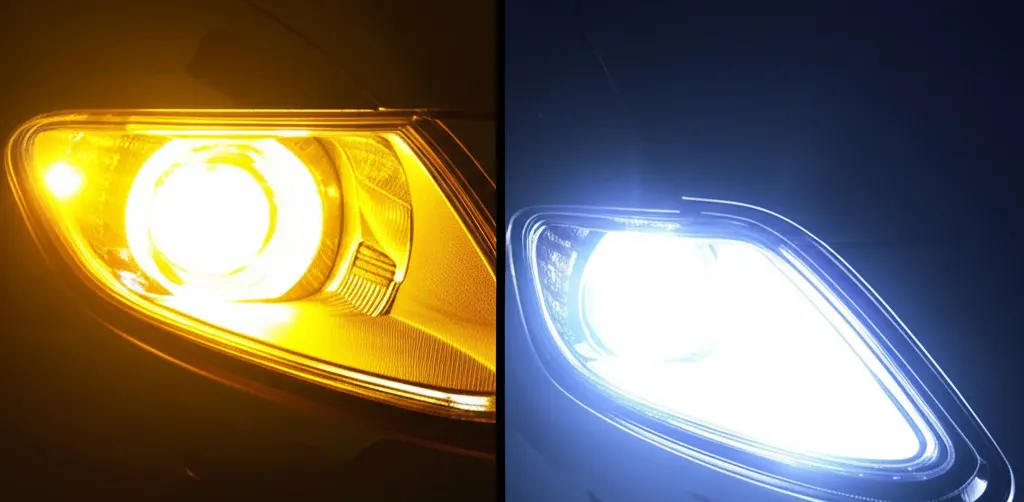
Almost every driver has experienced the sudden, disorienting shock of oncoming headlights that feel less like illumination and more like a high-intensity interrogation lamp. You squint against the glare, glance toward the white fog line on the right shoulder, and hope you stay on the road until the other vehicle passes. More often than not, that blinding vehicle is not running its high beams. It is a commuter sedan, an older pickup, or a crossover equipped with an aftermarket LED conversion kit installed inside a factory halogen headlight housing.
The temptation to swap out factory halogen bulbs for modern LEDs is easy to understand. Halogen bulbs produce a warm, yellowish glow that can look dated, and as their filaments age, their light output gradually fades. Online retailers are packed with plug-and-play LED replacement bulbs promising instant three-hundred percent brightness gains, a modern crisp white color, and a simple fifteen-minute installation for less than fifty dollars.
However, automotive lighting is not a simple game of swapping light bulbs like lamps in a living room. Headlight assemblies are precision-engineered optical instruments governed by the strict laws of geometric optics. When you insert a flat LED chip into a reflective housing designed around a microscopic tungsten filament, the optical physics break down completely. The result is an uncontrolled scatter of intense light that blinds oncoming traffic while giving the driver an illusion of superior nighttime vision.
The Optical Geometry of Factory Headlights
To understand why drop-in LED bulbs create severe glare, you have to look closely at how automotive lighting engineers design a halogen headlight assembly. A standard halogen reflector headlight consists of two core components working in unison: the light source and the optical reflector bowl.
The light source in a standard halogen bulb (such as an H4, H7, 9005, or 9006) is a tightly wound tungsten filament. This filament is exceptionally small, typically measuring roughly one to one-and-a-half millimeters in diameter and four to five millimeters in length. Because it is suspended in an open quartz capsule, the filament glows uniformly and emits light in a continuous, uninterrupted three-hundred-sixty-degree sphere.
The surrounding reflector bowl is not a generic shiny dome. It is a complex-surface, computer-calculated parabolic reflector divided into hundreds of distinct, microscopic reflective facets. Every single facet is shaped and angled with mathematical precision relative to one specific coordinate in three-dimensional space: the optical focal point where that hair-thin filament sits.
When the filament radiates light from that exact focal point, the parabolic facets capture the rays and redirect them downward and forward onto the road surface. This geometry creates a sharply defined beam pattern with an unmistakable horizontal cutoff line.
Light is distributed wide across both road shoulders, concentrated in a hot spot far down the driving lane, and aggressively blocked above horizontal eye level. This precise cutoff is the only reason you can illuminate the road two hundred feet ahead without projecting blinding light straight into the retinas of drivers traveling in the opposite direction.
The Focal Point Mismatch: Why Drop-In LEDs Break the System
Light-emitting diodes operate on an entirely different physical architecture than incandescent filaments, and this fundamental difference is where optical engineering fails in a retrofit scenario.
An LED is a solid-state semiconductor wafer mounted flat against a circuit board. It cannot radiate light in a spherical pattern. Instead, an LED die projects light forward in a hemispherical arc roughly one hundred and twenty degrees wide.
To mimic the omnidirectional output of a halogen bulb, aftermarket LED manufacturers typically mount two flat diode chips back-to-back on a central metal core. This design immediately introduces three critical optical defects:
First, the physical thickness of the central circuit board creates a permanent dead zone. The bulb casts light to the left and right, but leaves a dark shadow above and below, preventing the reflector bowl from receiving the continuous light distribution it was engineered to capture.
Second, the actual light-emitting surface of an LED chip is significantly larger than a filament. While a tungsten coil is a tight wire line, surface-mount diodes or chip-on-board arrays present a broad, rectangular patch of luminous area.
Third, and most importantly, the diodes rarely sit at the exact optical focal point of the reflector bowl. In optical engineering, even a fraction of a millimeter of displacement completely changes the angle of reflection.
When light originates outside the focal point, the parabolic facets cannot focus the rays downward. Instead of projecting a controlled, flat beam with a razor-sharp cutoff, the reflector bounces the light chaotically in every direction. Intense light rays spill upward into the trees, sideways off the road, and directly into the windshields and side mirrors of other motorists.
Re-aiming the headlight housing downward does not fix this problem. Because the light is scattered uncontrolled across the entire face of the lens, lowering the physical angle of the housing merely moves the central glare hotspot slightly lower while leaving substantial light scatter directly in oncoming drivers’ sightlines.
The Foreground Trap: Why Brightness Does Not Equal Visibility
Drivers who install LED bulbs into halogen reflectors often dismiss complaints from oncoming motorists because, from behind the steering wheel, the road appears dramatically brighter. The pavement directly in front of the vehicle glows in intense, daylight-white clarity.
This sensation of improved visibility is an optical illusion created by foreground light saturation, and it actively compromises your long-distance night vision through human biology.
The human eye functions through an adaptive aperture: the pupil. In low-light environments, your pupils naturally dilate to allow as much ambient light as possible to strike the retina, enabling you to detect dark shapes, pedestrians, and animals far down the unlit highway.
When an unshielded LED floods the first fifteen to thirty feet in front of your front bumper with excessive raw lumens, your eye registers that intense pool of foreground light as bright daylight. In response, your pupils immediately constrict to protect the retina from overexposure.
While the patch of asphalt right over your hood looks intensely illuminated, your distance vision is severely compromised. With constricted pupils, your eyes struggle to penetrate the darkness beyond the artificial pool of foreground light. You can see gravel on the road directly in front of your tires with crisp detail, but your ability to spot a pedestrian walking along the shoulder two hundred feet ahead drops significantly. By the time an obstacle enters your pool of light, your stopping distance at highway speeds has already run out.
Projector Housings: A Partial Solution with New Complications
Many vehicle owners believe they can bypass these issues if their car came from the factory with projector headlights rather than open reflector bowls. A projector headlight uses a concentrated elliptical reflector, an internal metal shield, and a thick glass condenser lens to focus light.
Projector housings do have one clear advantage: the internal metal cutoff shield physically blocks stray upward light, which helps prevent raw beam scatter from blinding oncoming drivers. However, installing an LED bulb into a halogen-designed projector still creates substantial visibility problems.
Halogen projector bowls are shaped around the exact light dispersion of a filament. When an LED with back-to-back diodes is placed inside, the projector lens creates heavy optical aberrations. The beam pattern frequently develops severe dark voids directly in the center of the lane, surrounded by intense hot spots on the sides.
Furthermore, the condenser lens can bend the cool white light at the cutoff edge into intense chromatic aberration. Oncoming drivers sitting right at the cutoff threshold do not see a steady white beam; instead, as the vehicle bounces over minor road imperfections, oncoming drivers experience a rapid, disorienting flashing effect between complete darkness and piercing blue-white glare.
Color Temperature and the Science of Discomfort Glare
Beyond beam geometry and focal points, the spectral quality of aftermarket LED lighting plays a major role in driver blinding and visual fatigue.
Factory halogen bulbs operate at a warm color temperature between 3,000K and 3,200K, producing a soft, amber-tinted white light. In contrast, the vast majority of aftermarket LED bulbs are manufactured with color temperatures ranging from 6,000K to 6,500K, creating a sharp, cool white or blue-tinted beam.
Manufacturers favor this icy blue-white spectrum because the human eye perceives cooler light as visually brighter, making the product appear far more powerful during an initial test drive. However, shorter blue wavelengths introduce severe physiological challenges on the road:
Rayleigh scattering dictates that shorter wavelengths of light scatter far more readily than longer wavelengths when passing through particles. When cool blue-white light strikes airborne moisture, road mist, rain, snow, or road dust, it scatters into a hazy visual fog, dramatically reducing contrast for the driver while amplifying glare for everyone else.
Inside the human eye, blue wavelengths trigger higher rates of intraocular light scatter. As light enters the eye, shorter wavelengths scatter across the internal cornea and lens, creating a cloudy haze across the retina known as disability glare.
This effect is especially severe for older drivers, whose ocular lenses naturally lose clarity over time. A warm halogen beam passing in the opposite lane is easy for the brain to process and ignore; an icy 6,500K beam from an unfocused LED creates an overwhelming wall of light that temporarily washes out the oncoming driver’s entire visual field.
Thermal Management and Longevity Realities
Marketing for aftermarket LEDs routinely claims operational lifespans of thirty thousand to fifty thousand hours. While individual LED diodes can theoretically last that long in controlled environments, the harsh thermal reality inside a headlight housing paints a completely different picture.
Halogen bulbs produce tremendous heat, but they radiate almost all of that thermal energy forward through the front of the housing as infrared light. The base and socket of the bulb stay relatively cool.
LEDs function in reverse. The light projected from the front of an LED die contains almost zero infrared heat. Instead, all the heat generated by the semiconductor is conducted backward directly into the base of the bulb.
To keep the semiconductor from melting itself within minutes, drop-in LED bulbs require large aluminum heat sinks, braided copper straps, or miniature high-speed cooling fans built into the mounting base.
Most modern vehicle headlight housings are completely sealed against the elements with rubber dust boots to keep out moisture and road grit. When an LED bulb is locked inside that sealed enclosure, the cooling fan simply circulates scorching air inside a closed plastic box. As ambient temperatures rise inside the housing, the LED drivers encounter thermal throttling, causing the bulb to automatically dim by thirty to fifty percent after twenty minutes of highway driving.
Worse still, if the miniature cooling fan ingests dust or fails mechanically, the semiconductor rapidly overheats, resulting in flickering, color shifting to an ugly purple hue, and premature electronic failure.
The Legal Reality: Off-Road Disclaimers
Because drop-in LED replacement bulbs cannot duplicate the physical geometry of an incandescent filament, they cannot meet standard automotive safety requirements.
In the United States, automotive lighting is strictly governed by Federal Motor Vehicle Safety Standard 108 (FMVSS 108), administered by the National Highway Traffic Safety Administration (NHTSA). Under FMVSS 108, replaceable light sources must adhere to rigorous physical dimensions, filament placements, and luminous flux limits.
There is currently no provision in federal regulations that certifies a drop-in LED replacement bulb as compliant for use in a halogen headlight housing on public highways.
Every reputable manufacturer of aftermarket LED bulbs knows this. If you inspect the packaging or fine print on the instruction manual of almost any aftermarket LED conversion kit sold online, you will find a mandatory legal disclaimer stating the bulbs are for off-road use only or intended exclusively for fog lights and show vehicles. Installing them in a forward-facing halogen headlight on a street-driven car violates federal equipment standards and state vehicle inspection codes.
How to Truly Improve Nighttime Visibility Safely
If your factory headlights leave you struggling to see down dark rural roads, you do not have to accept poor lighting or resort to blinding your fellow motorists. Several proven, optically sound methods can restore and dramatically upgrade your vehicle’s forward lighting:
Restore Cloudy Polycarbonate Lenses
Before spending money on any lighting upgrades, look closely at the clear front plastic covers of your headlight housings. Modern headlights are molded from polycarbonate plastic coated with a thin UV-protective film. Over five to ten years of sun exposure and road debris, that protective layer oxidizes, turning the clear plastic into a hazy, yellowed, cloudy surface.
A cloudy lens can easily block forty to sixty percent of the light emitted by your bulbs, scattering the beam before it ever leaves the car. Using a professional wet-sanding and polishing headlight restoration kit, followed by a durable UV ceramic clear coat, will restore crystal clarity and return your factory lighting performance to showroom levels.
Upgrade to Premium High-Efficacy Halogen Bulbs
Not all halogen bulbs are built the same. Basic replacement bulbs purchased from local auto parts stores are designed for maximum lifespan, using thick, durable filaments that produce modest light output.
Performance halogen bulbs from established lighting manufacturers utilize precision-wound, higher-luminance filaments running inside specialized mixtures of xenon and halogen gas under high pressure. These bulbs fit the factory focal point perfectly, maintain full compliance with safety standards, and project significantly more usable light far down the road without introducing stray glare. While high-performance halogens have shorter service lives than standard long-life bulbs, they provide a major, street-legal visibility upgrade.
Check Wiring and Voltage Drop
Halogen light output is exceptionally sensitive to operating voltage. If a vehicle’s aged wiring harness, corroded ground point, or headlight relay delivers only 11.5 volts to the bulb socket instead of a healthy 13.8 volts from the alternator, light output can drop by more than thirty percent.
Inspecting your headlight ground wires for corrosion or installing a dedicated relay harness that pulls clean, full voltage directly from the battery can dramatically brighten your existing halogen setup without altering the factory beam pattern.
Install Complete, Certified LED Headlight Assemblies
If you are committed to the crisp look and high output of modern LED technology, the correct and responsible path is to replace the entire headlight housing assembly.
DOT and SAE-compliant complete LED headlight units are engineered from the ground up around solid-state diodes. Their internal reflectors, projection lenses, and internal cutoff shields are tailored specifically to the diodes powering them, paired with massive external heat sinks engineered to shed thermal loads safely outside the housing.
A complete engineered assembly provides the intense, uniform illumination and modern aesthetic you want, while maintaining the strict horizontal cutoff lines that keep oncoming traffic safe.
Taking the time to upgrade your lighting through proper optical engineering ensures that your path forward is clearly illuminated, without compromising the safety of everyone sharing the road with you.
